Landfill waste converted into saleable soil product
Seattle, WA
Island County Solid Waste Division began screening mixed landfill material using a FlipScreen bucket to recover reusable soil and aggregates. By processing material directly at the landfill, operators separated organic soil from debris and oversize waste. The screened product was repurposed as a saleable soil material for landscaping and public works projects.
Island County Solid Waste Division
Landfill sites frequently accumulate large volumes of mixed material containing soil, organic matter, construction debris and general waste. At Island County’s facility near Seattle, much of this material contained recoverable soil that could potentially be reused if it could be separated efficiently from rubbish and oversize debris. Traditionally this material was treated as landfill cover or disposed of entirely, missing an opportunity to recover useful resources. The waste division wanted to explore ways to divert more material from landfill while reducing processing costs. Any solution needed to operate within an active landfill environment and handle inconsistent, often abrasive waste streams.
Challenge
The department introduced a FlipScreen WL130 screening bucket to process stockpiled waste material directly within the landfill site. Operators used a loader to place mixed material into the rotating screening drum, allowing fine soil and organic material to pass through the mesh while larger waste items remained separated. By selecting different screen sizes, the team could produce a consistent grade of screened soil suitable for landscaping applications or landfill rehabilitation projects. Because the FlipScreen attaches to existing machinery, it could be moved around the site easily, allowing operators to process material wherever stockpiles accumulated.
Solution
The screening program enabled Island County Solid Waste Division to recover significant quantities of reusable soil from landfill material that would otherwise have remained buried. The screened soil product was repurposed for local landscaping projects, erosion control and landfill rehabilitation, and in some cases made available as a saleable material. This reduced the amount of waste being permanently buried while creating a useful resource from previously discarded material. The ability to process waste onsite also reduced handling costs and simplified site operations. Overall, the initiative helped improve landfill diversion rates while delivering both environmental and financial benefits.
Result
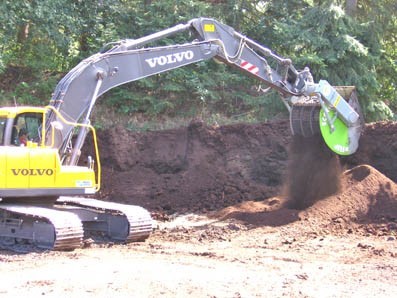
FlipScreen WL130 screens landfill material for reuse.
Waste Management
WL130
Mixed Waste
Industry:
FlipScreen Model:
Material:
Landfill waste converted into saleable soil product
Seattle, WA
Landfill sites frequently accumulate large volumes of mixed material containing soil, organic matter, construction debris and general waste. At Island County’s facility near Seattle, much of this material contained recoverable soil that could potentially be reused if it could be separated efficiently from rubbish and oversize debris. Traditionally this material was treated as landfill cover or disposed of entirely, missing an opportunity to recover useful resources. The waste division wanted to explore ways to divert more material from landfill while reducing processing costs. Any solution needed to operate within an active landfill environment and handle inconsistent, often abrasive waste streams.
Challenge
The department introduced a FlipScreen WL130 screening bucket to process stockpiled waste material directly within the landfill site. Operators used a loader to place mixed material into the rotating screening drum, allowing fine soil and organic material to pass through the mesh while larger waste items remained separated. By selecting different screen sizes, the team could produce a consistent grade of screened soil suitable for landscaping applications or landfill rehabilitation projects. Because the FlipScreen attaches to existing machinery, it could be moved around the site easily, allowing operators to process material wherever stockpiles accumulated.
Solution
The screening program enabled Island County Solid Waste Division to recover significant quantities of reusable soil from landfill material that would otherwise have remained buried. The screened soil product was repurposed for local landscaping projects, erosion control and landfill rehabilitation, and in some cases made available as a saleable material. This reduced the amount of waste being permanently buried while creating a useful resource from previously discarded material. The ability to process waste onsite also reduced handling costs and simplified site operations. Overall, the initiative helped improve landfill diversion rates while delivering both environmental and financial benefits.
Result
Waste Management
WL130
FlipScreen WL130 screens landfill material for reuse.
Mixed Waste
Industry:
FlipScreen Model:
Material:
Island County Solid Waste Division began screening mixed landfill material using a FlipScreen bucket to recover reusable soil and aggregates. By processing material directly at the landfill, operators separated organic soil from debris and oversize waste. The screened product was repurposed as a saleable soil material for landscaping and public works projects.
Island County Solid Waste Division
Landfill waste converted into saleable soil product
Seattle, WA
Landfill sites frequently accumulate large volumes of mixed material containing soil, organic matter, construction debris and general waste. At Island County’s facility near Seattle, much of this material contained recoverable soil that could potentially be reused if it could be separated efficiently from rubbish and oversize debris. Traditionally this material was treated as landfill cover or disposed of entirely, missing an opportunity to recover useful resources. The waste division wanted to explore ways to divert more material from landfill while reducing processing costs. Any solution needed to operate within an active landfill environment and handle inconsistent, often abrasive waste streams.
Challenge
The department introduced a FlipScreen WL130 screening bucket to process stockpiled waste material directly within the landfill site. Operators used a loader to place mixed material into the rotating screening drum, allowing fine soil and organic material to pass through the mesh while larger waste items remained separated. By selecting different screen sizes, the team could produce a consistent grade of screened soil suitable for landscaping applications or landfill rehabilitation projects. Because the FlipScreen attaches to existing machinery, it could be moved around the site easily, allowing operators to process material wherever stockpiles accumulated.
Solution
The screening program enabled Island County Solid Waste Division to recover significant quantities of reusable soil from landfill material that would otherwise have remained buried. The screened soil product was repurposed for local landscaping projects, erosion control and landfill rehabilitation, and in some cases made available as a saleable material. This reduced the amount of waste being permanently buried while creating a useful resource from previously discarded material. The ability to process waste onsite also reduced handling costs and simplified site operations. Overall, the initiative helped improve landfill diversion rates while delivering both environmental and financial benefits.
Result
Waste Management
WL130
FlipScreen WL130 screens landfill material for reuse.
Mixed Waste
Industry:
FlipScreen Model:
Material:
Island County Solid Waste Division began screening mixed landfill material using a FlipScreen bucket to recover reusable soil and aggregates. By processing material directly at the landfill, operators separated organic soil from debris and oversize waste. The screened product was repurposed as a saleable soil material for landscaping and public works projects.
Island County Solid Waste Division

6 a.m - 9 p.m (Mon - Sun)
contact@strongx.com
+259 (0) 256 215